Meet the Woman Teaching High-Performers How to Exhale
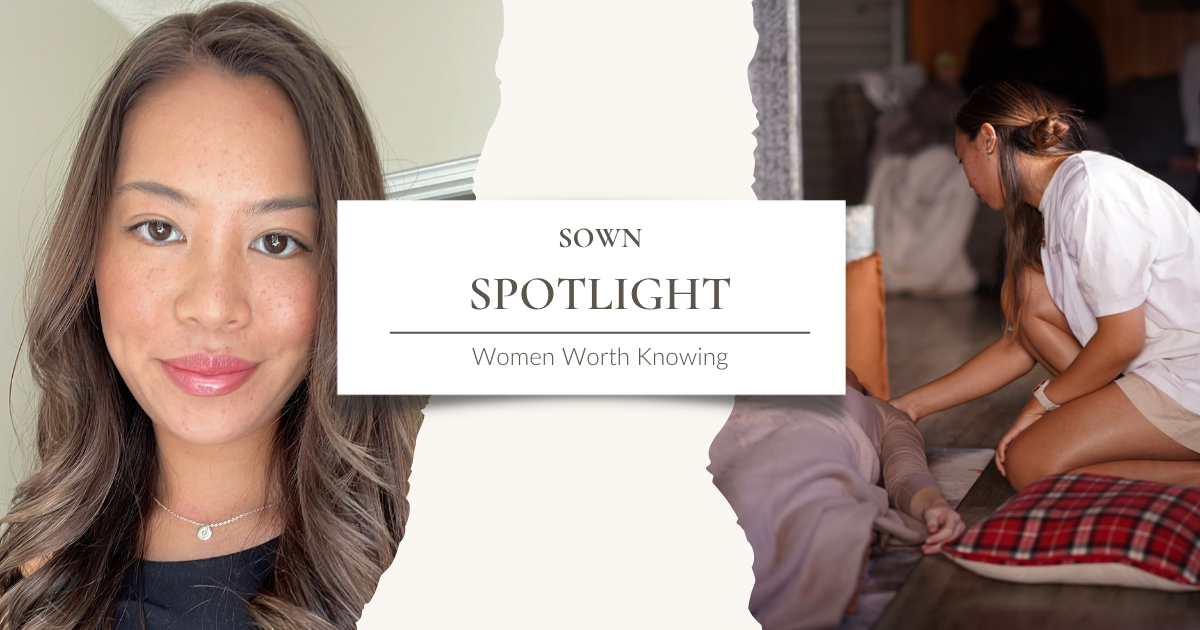
If you've been with SOWN from the beginning, you know the drill: periodically, I spotlight a woman doing incredible, transformational work in the intentional living, slow living, and wellness space. This month, I am so honored to introduce you to Bridgitte Tran, founder of DUMP Breathwork.
Bridgitte is a former chiropractor turned breathwork practitioner and perimenopause guide for high-performing women. She works at the intersection of body, hormones, and nervous system, and she does it with the kind of warmth and clarity that makes you feel held from the moment you walk into her space.
I didn't just interview Bridgitte. I took her class first. And I need you to know — my heart rate was 88bpm when I walked in and 56bpm when I walked out. That alone tells you something but the conversation we had afterwards told me even more.
After class, Bridgitte and I sat down in her studio and talked about everything from perimenopause to purpose to what it actually means to restore yourself. Here's a glimpse of that conversation. The full interview continues below.
On Women in Seasons of Reinvention
A lot of women who read SOWN are in a season of reinvention. They're leaving jobs, shedding relationships, and outgrowing versions of themselves they once fought hard to become. I wanted to know what kept Bridgitte moving forward when she was in the middle of her own pivot from a career in chiropractic to building something entirely new.
Her answer was one of those things you already know in your bones but haven't found the words for yet. She put it this way: if you fast-forward your current situation five, ten years, and that picture isn't something you can live with, then the bold, audacious choice is really the only choice.
"The cost of inaction is too high. You've chosen to make changes that are scary, they're dramatic, they really could uproot your life. But you've done that because you've projected what your circumstance looks like into the future, and that's just not acceptable for you. Change doesn't happen if change doesn't happen."
She paused and then said something I think every woman in transition needs to hear: "You've done the right thing. You're on the right path. It's really scary, but it is the only thing that you could have done."
The Difference Between Rest and Restoration
This is something I've been sitting with for a while, and I know I'm not the only one. How many of us spend the weekend sleeping, doing nothing, calling it rest, and still wake up on Monday feeling like we haven't actually recovered? I asked Bridgitte about the difference between rest and restoration, because I think a lot of women are confusing the two.
She described rest the way most of us experience it; you might be lying down, but your mind is still running. Nothing underneath actually shifts. However, restoration, on the other hand, is something you feel in your body in a way you can't ignore. She called it regulation, stillness, peace. The kind of space where your body can actually heal.
"Rest feels topical," she said. "It's short-term treatment of a symptom. Restoration goes deep — it's where everything stems from. It's where your control is. To make decisions properly, to think clearly, to speak your mind, and not be triggered. That's a deep nervous system level."
The Perimenopause Conversation We're Not Having
I'll be honest, as a woman in my early 30s, perimenopause was the last thing on my mind. Until sitting across from Bridgitte, I realised that's exactly the problem. We don't think about it because nobody talks about it. By the time we're in it, we're already years deep without understanding what's happening.
Bridgitte broke it down in a way I hadn't heard before. Perimenopause isn't a single event; it's a transition that can last eight to ten years, and it can start as early as our late 30s. Eight to ten years of hormonal fluctuation, mood shifts, sleep disruption, and changes that are very, very real.
"If we don't know what's going on," she said, "then how can we expect men, who will never go through the same process, to understand and give us grace? I hear a lot of men referring to their partners as moody or touchy. All of these things are so minimizing to women. But for women, there's an actual hormonal shift, big bodily changes that are happening, which give her these symptoms. They're very real, and that's the truth."
She talked about the bucket analogy, our capacity and tolerance as a container that gets filled by hormonal changes, daily stress, anxiety about what's happening to our bodies, and the self-criticism that comes with not understanding any of it. When that bucket overflows, that's burnout. That's when we can't cope anymore.
Breathwork, she explained, is a way of taking water out of the bucket. It shifts your physiology, helps you process what's been sitting in your body, and protects your capacity from overflowing. It's not about adding another thing to the routine; it's about unloading what's unnecessarily there.
How Breathwork Feeds Intentional Living
I wanted to zoom out from perimenopause and talk about all women of every age who are trying to live more intentionally. So I asked Bridgitte how breathwork fits into that.
Her answer made me laugh because it was so true: "You don't just stumble upon breathwork. It's typically like a friend dragged you there because they went to some yoga thing, and you're dragging your feet thinking it's so hippy."
But then she got serious. "When you taste it, and you understand what it is, you really lean into it. That's when you become intentional. You go back to the space because you know what it offered you before."
There's something in that I want to sit with the idea that intentional living isn't always something you plan. Sometimes it starts with showing up somewhere you didn't want to be, and realising it gave you exactly what you needed.
What Taking Root Looks Like for Bridgitte
If you know SOWN, you know I always come back to this idea of planting — of women building lives with intention and putting down roots in whatever season they're in. So I asked Bridgitte what taking root means to her right now.
She told me I'd asked at the perfect time.
"All of the work I've done previously, especially because I left behind my first career, I felt like I planted a lot of seeds. I committed time and energy, and then I had a lot of time to rest. I was really burnt out. But during that time, when I was forced to not do things, seeds were planted in me as well. I was looking at people, reflecting on my choices, being exposed to what my life could look like."
She talked about how her background in health helps her explain what's happening in our bodies, and how her own experiences with burnout, anxiety, depression, and losing her sense of identity help her relate to the women who walk through her door. All of those scattered seeds like the career change, the dark seasons, the slow rebuilding, have taken root into something that looks, in her words, really nice.
"It's integrating things that I love to do, people I love to be around, learn from everybody around me. It's all coming to this nice place where I can share my creativity and live a life that I would really like."
Her Advice for Women Who Feel Stuck
Before we wrapped up, I asked Bridgitte what she'd say to a woman who feels like there's a purpose somewhere inside her but doesn't know how to reach it.
Her advice was to follow the paths with the least resistance. Not in a passive way but in a pay-attention-to-what-feels-like-freedom way. If something drains you emotionally, financially, and spiritually, that's resistance telling you something. If something else makes you feel creative, free, and like yourself, that's worth leaning into.
"The resistance is great too," she added, "because you're finding your limits, your blacks and whites. You swing through those different shades of grey and finally pick somewhere in between that feels good for you."
And then she left me with this: "Know that you are on the right track. You're exactly where you need to be, so please don't stress that. You just have to trust that you're here for a reason. Maybe this burnout or this stuck period is just a way to re-pivot you. And you need that re-pivot, otherwise you'd keep going down this track forever, which leads to unfulfillment."
Final Thoughts
Sitting across from Bridgitte after her class, still feeling the calm in my body, I was reminded of something I believe deeply: the best conversations aren't the ones you plan for. They're the ones that happen when two women sit down, get honest, and let the conversation go wherever it needs to.
Bridgitte Tran is building something beautiful. If you're a woman who's been running on empty, holding it all together, and wondering why rest isn't fixing what's broken, her work might be exactly what you need.
You can find Bridgitte on Instagram at @dump_breathworkand learn more about her classes at dumpbreathwork.pushpress.com.
Keep planting. xx Ashlee